
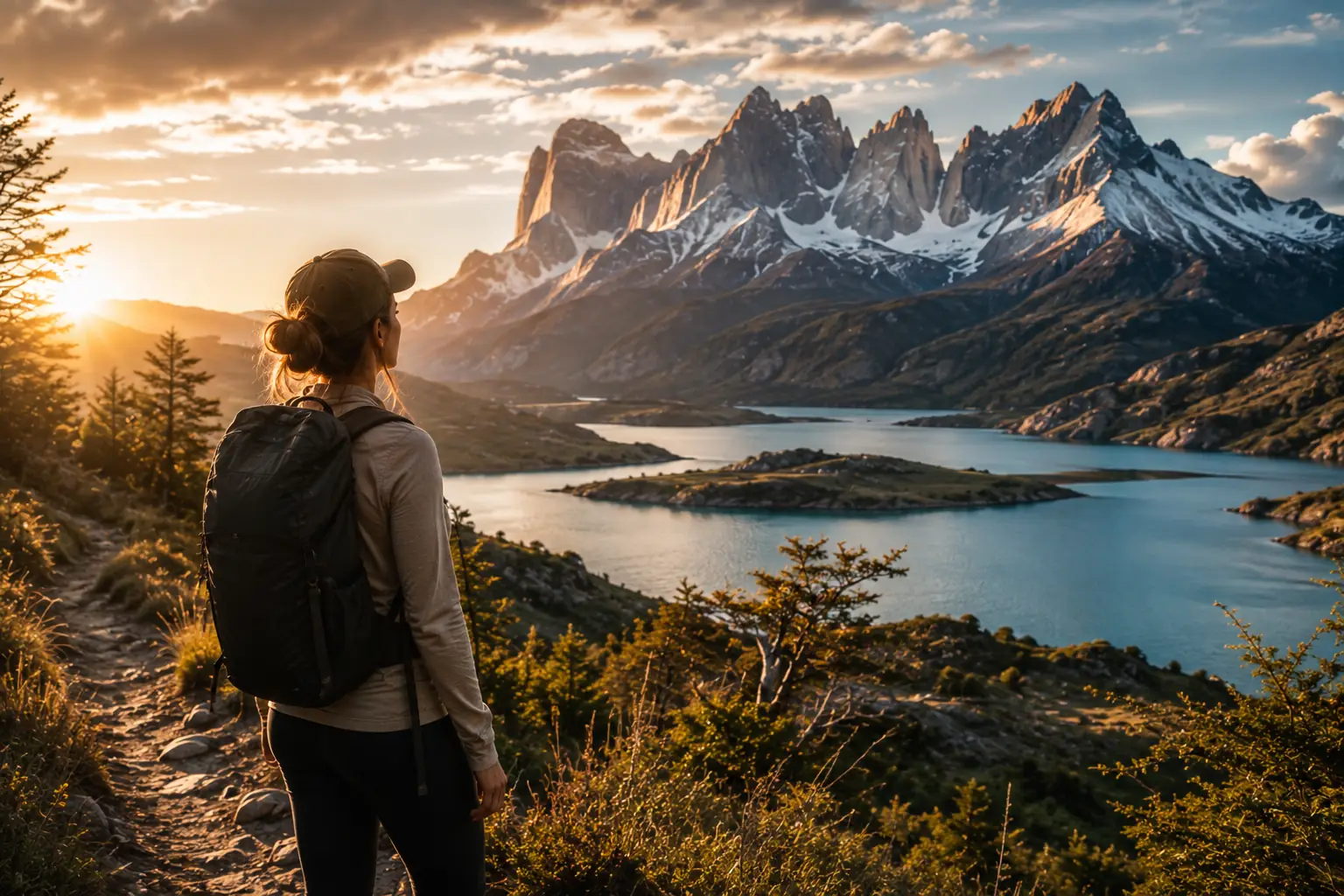
Why an active journey has very little to do with how far, fast or high you go.
There are places we can admire from a distance.
And there are places that invite us to step inside them.
Latin America is full of the latter.
The Andes, Patagonia, the Amazon, the Galápagos, Costa Rica’s forests, the vast landscapes of the Atacama — these are places where nature is not simply something to look at. It is something to experience.
Sometimes that means walking.
Sometimes riding a horse, kayaking across a lake, cycling through vineyards or navigating a river.
And sometimes it simply means slowing down enough to feel part of the landscape around you.
At Latitude Boreal, we believe movement can add an extraordinary dimension to a journey.
But we also believe something equally important:
The intensity is entirely yours.
Active means something different to everyone
When we talk about an active journey, we are not necessarily talking about adventure travel.
There are travellers who dream of spending four days walking the Inca Trail.
Others would love to experience its final section, arriving at Machu Picchu through the Sun Gate after a few hours on foot.
And others would rather arrive comfortably and explore the Sacred Valley through shorter walks, beautiful drives and experiences designed entirely around their own rhythm.
None is experiencing Peru better than the other.
They are simply experiencing it differently.
The same is true throughout Latin America.
One traveller may want to spend an entire day trekking through Patagonia; another may prefer a gentle walk followed by fly fishing beside a lake.
One might cross the foothills of the Andes on horseback; another might explore the same landscape by private 4×4.
In the Sacred Valley, it could mean cycling between villages — or taking an e-bike.
In Costa Rica, climbing and hiking around Arenal — or experiencing the rainforest from hanging bridges and carefully chosen trails.
The destination remains extraordinary. What changes is the way we move through it.
A different way of connecting with a place
There is something that happens when we experience a landscape physically rather than simply observe it.
We notice more.
The temperature.
The wind.
The altitude.
The smell of the vegetation.
The sound of water.
The way a landscape changes as we move through it.
Some of my own strongest memories of Patagonia come from moving through its mountains. I love running, and spending hours surrounded by that landscape has taught me how dramatically a place can change when you experience it slowly and physically.
Forests give way to exposed mountain terrain. Vegetation disappears. Temperatures fall. Wind, snow and silence take over.
But you don’t need to run a mountain race to experience that connection.
A forty-five-minute walk can do it.
So can an afternoon on horseback.
Or a kayak moving quietly across a lake.
What matters isn’t the distance.
It is the feeling of being inside the place rather than passing through it.
The power of being present
Perhaps this is one of the reasons movement and travel work so beautifully together.
Our everyday lives rarely stop.
There are messages to answer, decisions to make, places to be and an endless stream of things competing for our attention.
Nature has a wonderful ability to quiet some of that noise.
When you are walking a trail, navigating a river or riding across an open landscape, your attention naturally moves towards what is happening around you.
The next turn in the path.
The changing light.
Your breathing.
The sound of the forest.
For a little while, there is less space for everything else.
You are simply there.
And that sense of presence is something we increasingly look for when designing journeys.
Not because every trip needs to be transformative.
Sometimes a holiday can simply be a wonderful holiday.
But because giving ourselves moments of genuine connection with a place often creates the memories that remain long after we return home.
Sometimes the best way in is by water
Being active doesn’t necessarily mean being on your feet.
Some of Latin America’s most extraordinary wilderness is best experienced from the water.
The Galápagos is an obvious example.
A small expedition ship or private yacht allows you to move between islands, waking each morning somewhere different and stepping ashore to explore according to your own interests and ability — perhaps walking, snorkelling or kayaking, perhaps experiencing the wildlife in a gentler way.
The Peruvian Amazon has a similar rhythm.
The river becomes the road.
You navigate through the landscape and then decide how deeply you want to enter it: a forest walk, a quiet excursion by skiff, kayaking, wildlife observation or simply sitting on deck as the Amazon moves around you.
The adventure doesn’t always lie in physical effort.
Sometimes it lies in access.
In reaching somewhere remote and experiencing a part of the world that feels completely removed from everyday life.
Movement, without turning the journey into a challenge
This distinction matters to us.
An active journey should never feel like a test unless that is specifically what the traveller wants.
It can contain movement without being physically demanding.
A morning horseback ride can end with a long lunch overlooking the Andes.
A walk through Patagonia can be followed by an afternoon beside the fire.
Kayaking in the Sacred Valley can lead into a beautiful picnic.
A day exploring Galápagos can end back aboard a boat with a glass of wine as the sun disappears.
We like that contrast.
Movement and stillness. Adventure and comfort. Discovery and time to simply enjoy where you are.
And when somebody loves serious physical challenges, we can take that much further.
Multi-day trekking.
Long-distance riding.
Mountain biking.
Surfing.
Rafting.
Diving.
The landscape gives us enormous possibilities.
The question is never how active a journey should be.
It is how active you want yours to be.
Adventure should be accessible
We also don’t believe a sense of adventure should be determined by age or physical ability.
A traveller with limited mobility can still experience extraordinary wilderness.
They can navigate remote rivers, encounter wildlife, travel through enormous landscapes, spend time with remarkable people and feel deeply connected to nature.
The way into the experience may simply be different.
This is where thoughtful design matters.
Perhaps a long hike becomes a carefully selected shorter trail.
A bicycle becomes an e-bike.
Walking becomes horseback riding or a private vehicle.
A kayak becomes a boat.
The objective isn’t to make everyone experience a destination in the same way.
It is to find the right way for each person to experience it.
Designing around you
This is why, when we begin designing an active journey at Latitude Boreal, we don’t start with a list of activities.
We start with the traveller.
We want to understand how you normally spend your time, what you enjoy doing, what you have always wanted to try and how much movement you actually want to incorporate into your trip.
For some people, physical activity is an essential part of every day.
For others, one beautiful experience every few days is enough.
And within a family or group, those preferences may be completely different.
That’s fine too.
One person can hike while another explores somewhere differently. Some days everyone comes together; other experiences can be individual.
A bespoke journey should have that flexibility.
The itinerary adapts to the people travelling.
Not the other way around.
Let the landscape lead
Perhaps the simplest way to think about active travel is not to begin by asking:
What activity should we do?
Instead:
How does this place want to be experienced?
Patagonia might invite you to walk, ride or fish.
Mendoza to explore the foothills of the Andes on horseback before returning to the vineyards.
The Sacred Valley to hike, cycle or kayak.
The Amazon to navigate.
The Galápagos to swim, snorkel and move between islands.
Costa Rica to enter the forest.
Every landscape has its own rhythm.
And every traveller has theirs.
Finding the point where those two rhythms meet is where some of the most memorable journeys begin.
Because ultimately, being active when we travel isn’t about going further.
It isn’t about going faster.
And it certainly isn’t about proving anything.
It is simply another way of getting closer to a place.
And how close you want to get — and how you choose to get there — is entirely up to you.
The Latitude Journal